Primordial non-Gaussianity Measurement with DESI
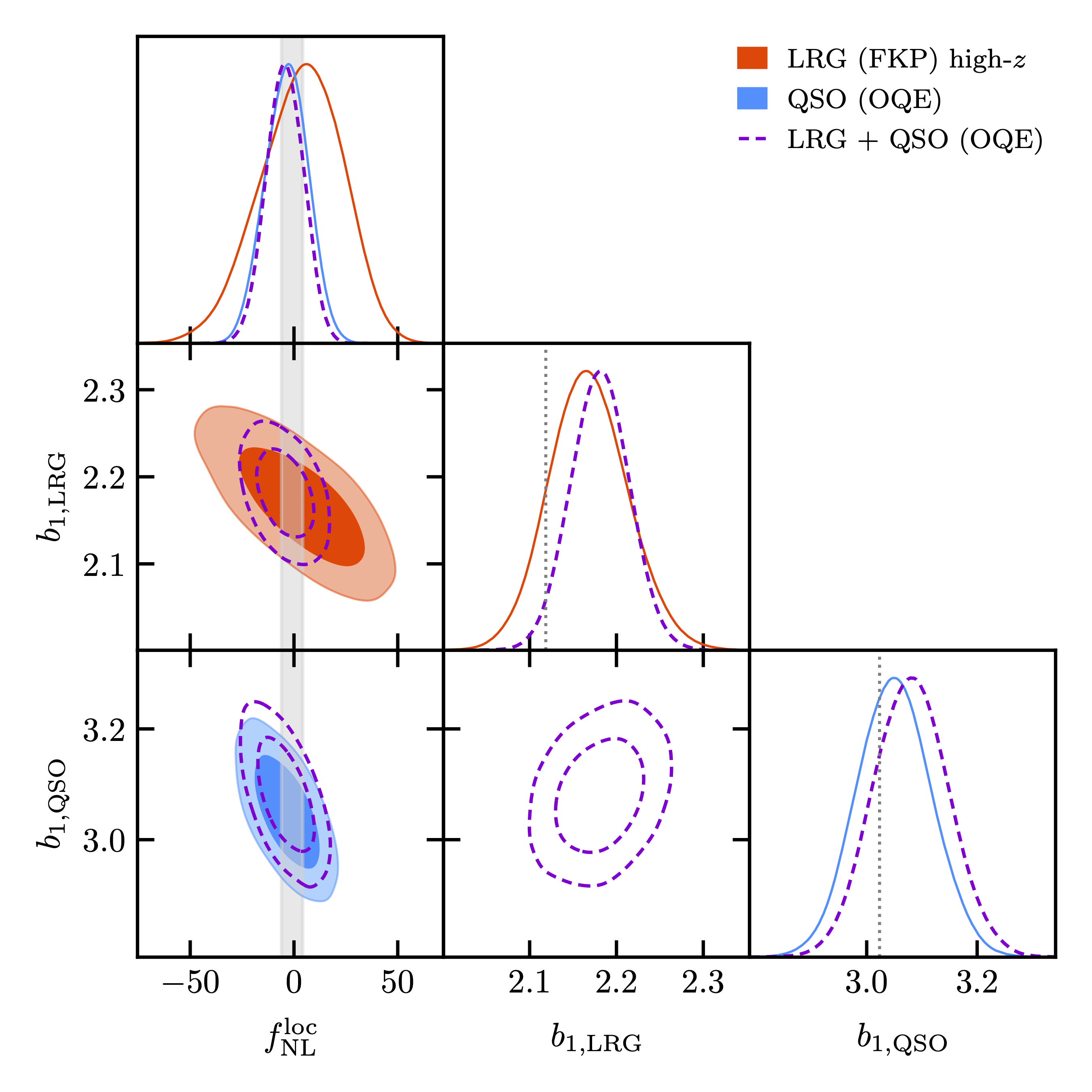
I published the state-of-the-art measurement of local PNG using galaxy survey [1] leading to the tightest constraint to date using galaxies. I dedicated the past 3 years to improve this measurement and be sure to mitigate any observational systematics. In particular, I developed a blinding strategy [2] that is applied by default in the DESI pipeline to avoid any confirmation bias when measuring the large-scale modes of the power spectrum. I was strongly involved in the clustering catalog pipeline of DESI [3,4], validating each step of the pipeline and improving the imaging systematic mitigation. Finally, I investigated alternative methodologies to constrain local PNG as the cross-correlation with the CMB lensing [5,6], the use of the density perturbation moments [7], or the inclusion of the cross-correlation between the different DESI tracers [8].
Highlights: [1] Chaussidon et al. 2025, [2] Chaussidon et al. 2024, [3] DESI Collaboration et al. 2024, [4] Ross et al. 2024, [5] Krolewski et al. 2023, [6] Chiarenza et al. 2026, [7] Vislosky et al. 2025, [8] Rosado-Marín et al. 2026